Spearman-Brown Prophecy Calculator
Predict how reliability changes when you lengthen or shorten a test. Enter the current reliability and how much you plan to change the number of items.
Learn how to calculate it yourselfEnter your values
Results update as you type.
Predicted reliability
predicted reliability at 2x length
Calculate it yourself
Predict reliability when a test with current reliability 0.70 is doubled in length.
Follow this worked example, then repeat the steps with your own numbers.
Find the length multiplier
k = new length ÷ old length = 2. Current reliability r = 0.70.Calculate numerator and denominator
Numerator = k × r = 1.40. Denominator = 1 + (k − 1)r = 1 + 0.70 = 1.70.Divide to get predicted reliability
New reliability = 1.40 ÷ 1.70 ≈ 0.824.
The prediction assumes added items have comparable quality and measure the same construct. A multiplier below 1 represents a shorter test.
Check your answer in the calculatorUse your PaperSurvey.io results
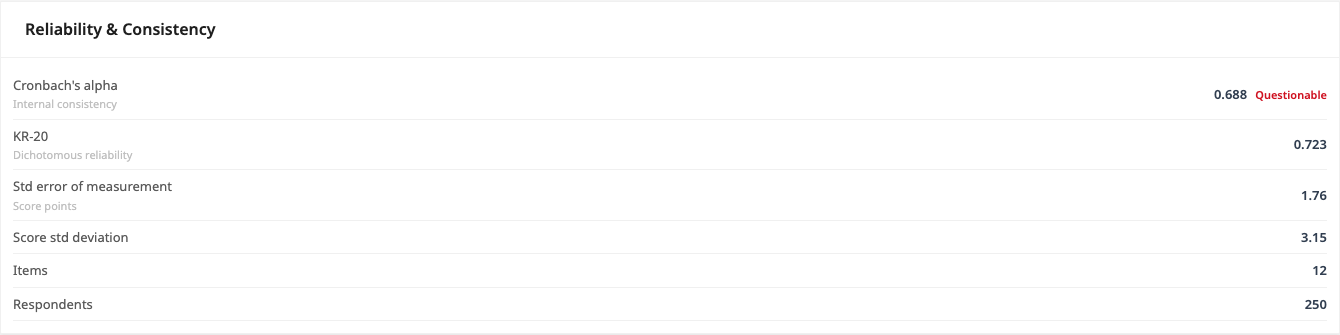
Use the assessment’s observed reliability as the starting point for a Spearman–Brown test-length projection.
What the formula predicts
The Spearman-Brown prophecy formula estimates the reliability a test would have after you change its length, assuming the new items are of the same quality as the current ones. Adding items generally raises reliability, and removing them lowers it, but with diminishing returns as the test gets longer.
How to use the factor
The length change factor is the new number of items divided by the current number. Use 2 to model doubling the test, 0.5 to model cutting it in half, or 1.5 to model adding 50% more items. Enter the reliability you already measured, for example a Cronbach’s alpha, as the current reliability.
Frequently asked questions
Is more length always better?
Longer tests are usually more reliable, but returns diminish and long tests tire respondents. The formula helps you find the shortest length that still reaches an acceptable reliability.
Get Started with PaperSurvey.io Software
Start your 14-day free trial now, no credit card required.