KR-20 Calculator
Measure the reliability of a test with right/wrong items. Paste a matrix with one student per line and 1 (correct) or 0 (incorrect) for each item.
Learn how to calculate it yourselfEnter your values
Results update as you type.
How to enter your data
Put each test-taker on their own line. On each line, type a 1 for every question that person got right and a 0 for every question they got wrong, separated by commas. Every line must have the same number of values, one value for each question.
KR-20 reliability
Check your inputs
Enter valid values to see your result. Use the field hints or open the data guide for help.
The KR-20 Reliability Calculator checks how consistent a right-or-wrong test is, such as a quiz where every question is scored simply as correct or incorrect. It gives you one number between 0 and 1 that shows whether the questions all seem to measure the same thing, so you can judge how much to trust the test's results. A higher number means the test is more reliable and dependable.
Calculate it yourself
Consider four students answering two right/wrong items: rows 1,1; 1,0; 0,1; and 0,0. A 1 means correct.
Follow this worked example, then repeat the steps with your own numbers.
Find the proportion correct on each item
k = 2 items. Both items have p = 2/4 = 0.5 and q = 1 − p = 0.5.Add the item p × q terms
Σpq = (0.5 × 0.5) + (0.5 × 0.5) = 0.5.Calculate the variance of total scores
Student totals = 2, 1, 1, 0; mean = 1. Sample variance s² = (1 + 0 + 0 + 1) ÷ (4 − 1) = 2/3.Substitute into KR-20
KR-20 = [k/(k − 1)] × [1 − Σpq/s²] = 2 × [1 − 0.5/(2/3)] = 0.5.
This reproduces the calculator’s convention of using sample variance for the total scores. Every row must contain the same items, scored only 0 or 1.
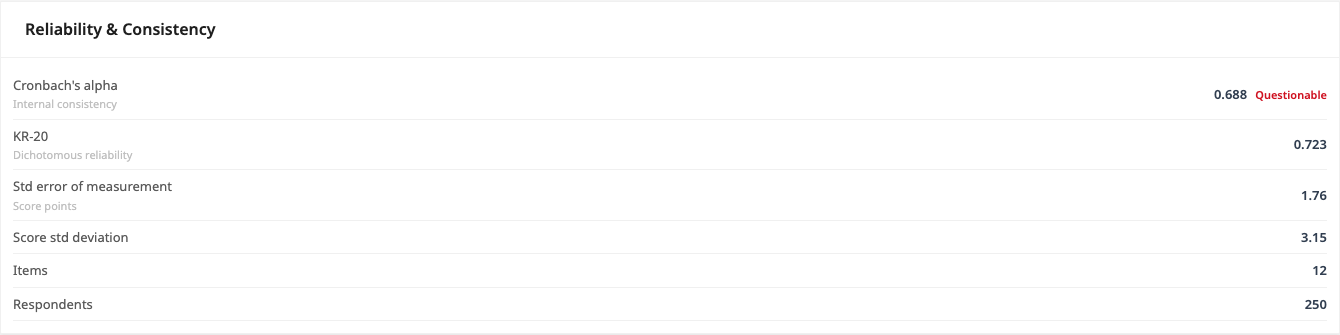
Check your answer in the calculatorBuilt into PaperSurvey.io
Add Reliability & Consistency to measure the internal consistency of graded right-or-wrong items.
Where it is used
- Teachers: A teacher marks a 20-question spelling quiz for 30 pupils and checks whether the questions work together as a reliable test.
- HR and training staff: An HR officer runs a pass-or-fail safety quiz for new hires and wants to know if the scores can be trusted before signing anyone off.
- Students and researchers: A student designing a true-or-false exam for a project checks whether the questions hold together well enough to report the results.
KR-20 vs Cronbach’s alpha
KR-20 is the special case of Cronbach’s alpha for dichotomous (right/wrong) items. Like alpha, values of 0.70 and above are generally considered acceptable reliability for a test.
When should you use it?
Use this calculator when you have a test where each answer is simply right or wrong, such as a spelling quiz, a multiple-choice exam marked correct or incorrect, or a pass-or-fail safety check. It also works for any question with two outcomes, like yes or no and true or false. You need the results from several people who took the same test. It is the right tool when every question is scored as one point or zero, not when answers are rated on a scale such as one to five.
What does the result mean?
The result is a single number between 0 and 1. It shows how well the questions work together to measure the same thing. The closer the number is to 1, the more reliable and consistent the test is. A common guideline is that 0.70 or higher is acceptable, 0.80 or higher is good, and 0.90 or higher is excellent. A score below 0.70 suggests the test may not be dependable, and some questions might be measuring different topics or pulling in different directions.
Mistakes to avoid
Do not use this on answers rated one to five or on star ratings; it only works for right-or-wrong, yes-or-no scoring. Make sure every line has the same number of values, one for each question, or the result will be wrong. Do not expect a perfect score of 1, because real tests rarely reach it. Using very few people or very few questions can make the number unstable and hard to trust. Finally, remember a high score means the test is consistent, not that it measures the right thing.
How to use this calculator
- Mark each answer on the test: write 1 for a correct answer and 0 for a wrong answer.
- Enter one test-taker per line, typing their 1s and 0s separated by commas.
- Check that every line has the same number of values, one value for each question.
- Read the score: closer to 1 means more reliable, and 0.70 or higher is usually considered acceptable.
Worked example
Say five pupils take a 4-question quiz. You enter each pupil's right and wrong marks on their own line, for example 1,1,0,1 for the first pupil and 0,1,1,1 for the next, and so on for all five. The calculator looks at how the questions performed together and returns a KR-20 of about 0.82, which means the quiz is reliable and its questions work well together.
Frequently asked questions
What do I type for each person?
Type one line for each test-taker. On that line, put a 1 for every question they got right and a 0 for every question they got wrong, with commas between the values.
Where do these 0s and 1s come from?
They come from marking each person's answers. Go through the test, and for each question write 1 if the answer was correct and 0 if it was wrong.
What counts as a good score?
Generally, 0.70 or higher is seen as acceptable, 0.80 or higher is good, and 0.90 or higher is excellent. Below 0.70 usually means the test is not very reliable.
Can I use this for star ratings or 1-to-5 answers?
No. KR-20 only works when each answer is one of two options, like right or wrong. For rating scales, a different measure called Cronbach's alpha is used instead.
Does a high score mean my test is accurate?
Not by itself. A high score means the questions are consistent with each other, but it does not prove the test measures the exact skill or topic you intended.
Get Started with PaperSurvey.io Software
Start your 14-day free trial now, no credit card required.