KR-21 Calculator
Estimate the reliability of a right/wrong test from summary statistics alone. Enter the number of items, the mean total score and the variance of scores.
Learn how to calculate it yourselfEnter your values
Results update as you type.
KR-21 reliability
questionable reliability
Calculate it yourself
Use a 10-item right/wrong test with mean total score 7 and total-score variance 6.
Follow this worked example, then repeat the steps with your own numbers.
Write down the three quantities
k = 10 items; M = 7 mean points; s² = 6 variance of total scores.Use variance here, not standard deviation.
Calculate the equal-difficulty term
M(k − M) ÷ (k × s²) = 7 × (10 − 7) ÷ (10 × 6) = 21/60 = 0.35.Apply the item-count adjustment
KR-21 = [k/(k − 1)] × [1 − 0.35] = (10/9) × 0.65 ≈ 0.722.
KR-21 assumes the items are equally difficult. If item-level responses are available, KR-20 can account for different item difficulties.
Check your answer in the calculatorUse your PaperSurvey.io results
Use the item count and total-score summaries from a graded assessment to calculate KR-21 separately.
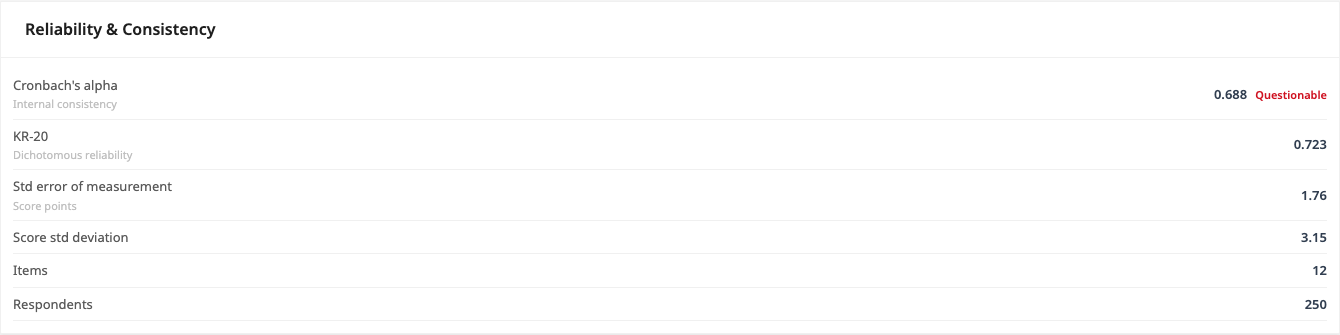
KR-21 vs KR-20
KR-21 is a quicker estimate than KR-20. It needs only the number of items, the mean score and the score variance, rather than every student’s answer to every item. In exchange it assumes all items are equally difficult, an assumption that rarely holds exactly, so KR-21 is usually a slight underestimate of the true reliability.
When it is handy
Use KR-21 when you have the summary statistics from a scoring report but not the full item-by-item response matrix. If you do have the raw right/wrong responses, KR-20 gives a more accurate figure.
Frequently asked questions
What is an acceptable KR-21 value?
As with KR-20 and Cronbach’s alpha, 0.70 and above is generally considered acceptable for a test, and 0.80 and above is good.
Get Started with PaperSurvey.io Software
Start your 14-day free trial now, no credit card required.