Intraclass Correlation (ICC) Calculator
Measure how consistently raters score the same subjects. Paste one row per subject with each rater’s numeric score.
Learn how to calculate it yourselfEnter your values
Results update as you type.
ICC(2,1) single measures
Check your inputs
Enter valid values to see your result. Use the field hints or open the data guide for help.
Calculate it yourself
For three subjects rated by two raters, use the score rows 1,2; 2,3; and 3,4.
Follow this worked example, then repeat the steps with your own numbers.
Calculate the means
n = 3 subjects; k = 2 raters. Grand mean = 2.5; subject means = 1.5, 2.5, 3.5; rater means = 2, 3.Calculate subject and rater mean squares
MSR = k × Σ(subject mean − grand mean)² ÷ (n − 1) = 2. MSC = n × Σ(rater mean − grand mean)² ÷ (k − 1) = 1.5.Calculate the residual mean square
Total sum of squares = 5.5. Subject sum = 4; rater sum = 1.5. MSE = (5.5 − 4 − 1.5) ÷ [(3 − 1)(2 − 1)] = 0.Calculate single-rater absolute agreement
ICC(2,1) = (MSR − MSE) ÷ [MSR + (k − 1)MSE + (k/n)(MSC − MSE)] = 2 ÷ 3 ≈ 0.667.Calculate reliability of the average rating
ICC(2,k) = (MSR − MSE) ÷ [MSR + (MSC − MSE)/n] = 2 ÷ 2.5 = 0.8.
This is the two-way random-effects, absolute-agreement form. The example raters track subjects perfectly but differ consistently by one point, so absolute agreement is below 1.
Check your answer in the calculatorUse your PaperSurvey.io results
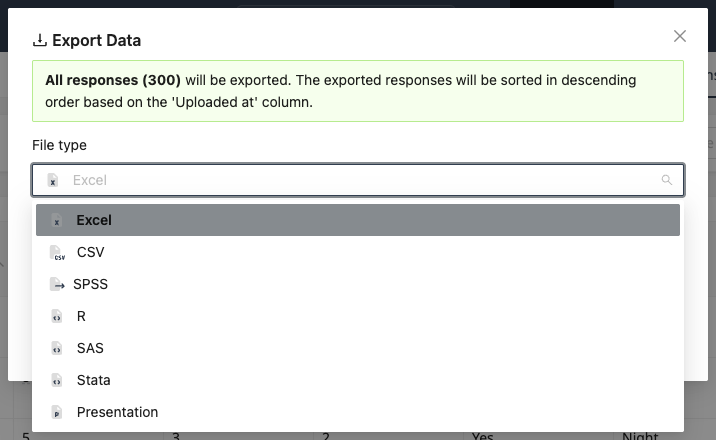
Record each rater’s numeric score for the same subjects and use the resulting matrix to calculate ICC here.
Single vs average measures
Single-measures ICC estimates the reliability of one rater’s score, which is what you want when a single rater will score each subject in practice. Average-measures ICC estimates the reliability of the mean of all raters, which applies when you will always average several raters together. This tool reports both.
Which form this uses
This calculator computes the two-way random-effects, absolute-agreement form, ICC(2,1) and ICC(2,k), the version usually reported for inter-rater reliability. Common interpretation bands are: below 0.5 poor, 0.5 to 0.75 moderate, 0.75 to 0.9 good and above 0.9 excellent.
Frequently asked questions
How is ICC different from Cohen’s kappa?
Kappa is for categorical ratings, where raters pick a category. ICC is for numeric ratings on a continuous scale, and it credits partial agreement between close scores rather than treating any mismatch as full disagreement.
Get Started with PaperSurvey.io Software
Start your 14-day free trial now, no credit card required.