Keeping your dataset clean is essential for accurate analysis. Whether you need to remove test submissions, duplicate entries, or responses with invalid data, PaperSurvey lets you selectively delete specific responses while preserving the rest of your data.
By combining the table filter with bulk actions, you can quickly locate and remove exactly the responses you do not need.
Step-by-Step Instructions
1. Enable edit mode
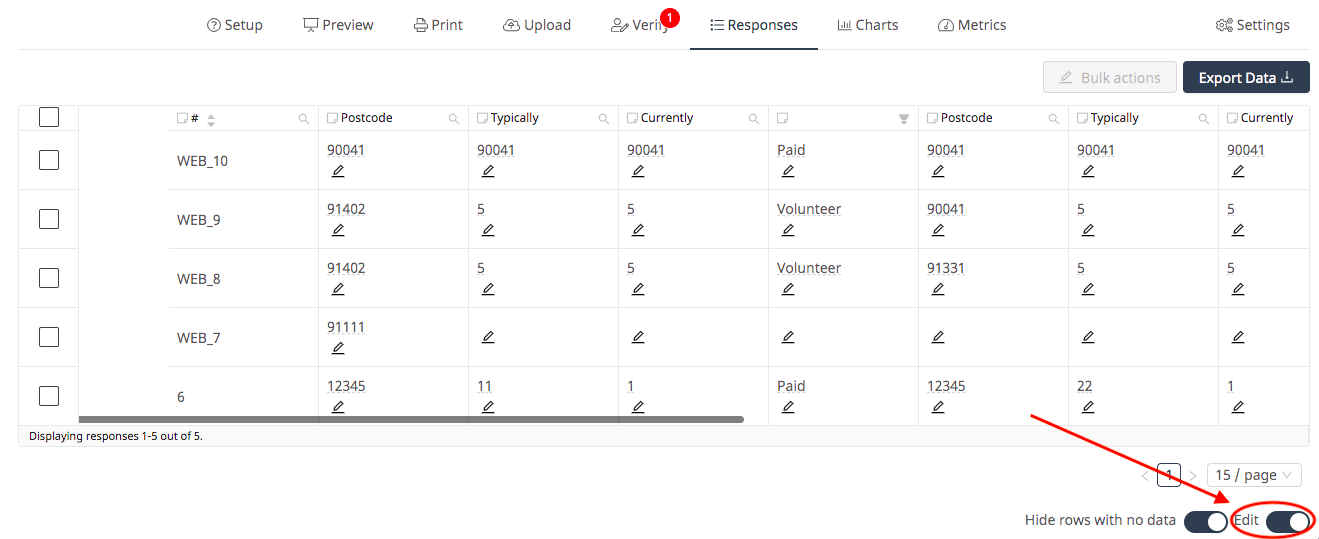
Navigate to your survey's responses page and click the "Edit" button in the bottom-right corner.
2. Find responses to delete
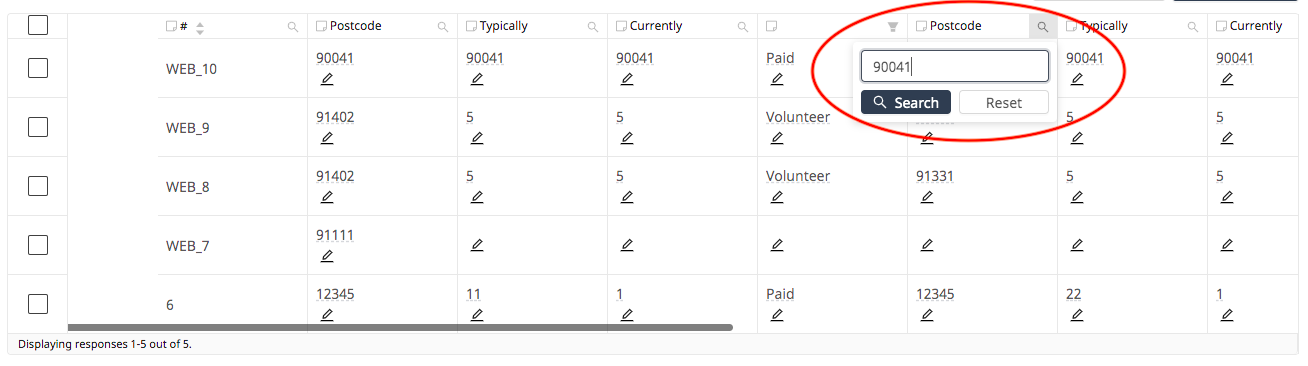
Use the table filter to locate specific responses. Click the search icon in the table header, enter keywords, values, or identifiers, and the table will show only matching responses.
3. Select filtered responses
After filtering, click the checkbox at the top-left corner of the table to select all visible (filtered) responses. Verify the selection shows the correct number of entries.

4. Delete selected responses
Click the "Bulk Actions" button, choose "Delete" from the dropdown menu, and confirm the deletion when prompted.

Filtering for Accurate Selection
Search by specific values
- Exact matches: Enter complete values like email addresses or ID numbers
- Partial matches: Use keywords that appear in responses
- Date ranges: Filter by submission dates to find old test data
- Response status: Filter by completion status or tags
Multiple criteria
Combine filters for precise selection. For example, filter by date and specific answer values, search by respondent information and response quality, or use tags to group responses before filtering.
Important Considerations
Before deleting
- No automatic recovery: Deleted responses cannot be restored through the interface
- Export first: Save a backup of your data before bulk deletions
- Double-check filters: Ensure filters show only unwanted responses
- Count verification: Confirm the number of selected items matches expectations
Impact on analysis
Deletion immediately affects all reports and exports. Shared dashboards will reflect the changes, and response counts and statistics update automatically.
Alternative Approaches
Instead of permanent deletion, consider these options:
- Tagging: Mark responses as "test" or "invalid" and filter them out during analysis
- Archiving: Export unwanted responses before deletion for record-keeping
- Separate analysis: Create filtered views without deleting data
- Status updates: Mark responses as inactive rather than deleting