Test Grade Calculator
Turn points into a percentage grade. Enter the points earned and the total points available.
Learn how to calculate it yourselfEnter your values
Results update as you type.
How to enter your data
This calculator has two boxes. Type the points earned in the first box (Points earned) and the total points the test was worth in the second box (Total points). Use plain whole or decimal numbers only, for example 42 and 50, with no percent signs, letters, or extra text.
Grade
The Test Grade Percentage Calculator turns a raw test score into a percentage. You enter how many points were earned and the total points the test was worth, and it works out the score as a percentage. For example, 42 out of 50 becomes 84 percent. It is a quick way to see how well someone did without doing the maths by hand.
Calculate it yourself
Example: a student earns 7 out of 10 points in one section and 11 out of 14 in another.
Follow this worked example, then repeat the steps with your own numbers.
Add the points earned
Points earned = 7 + 11 = 18Add the points available
Total possible points = 10 + 14 = 24Convert to a percentage grade
Grade = points earned ÷ total points × 100 = 18 ÷ 24 × 100 = 75%
This treats every point equally. If sections have separate percentage weights, use a weighted grade calculation instead.
Check your answer in the calculatorBuilt into PaperSurvey.io
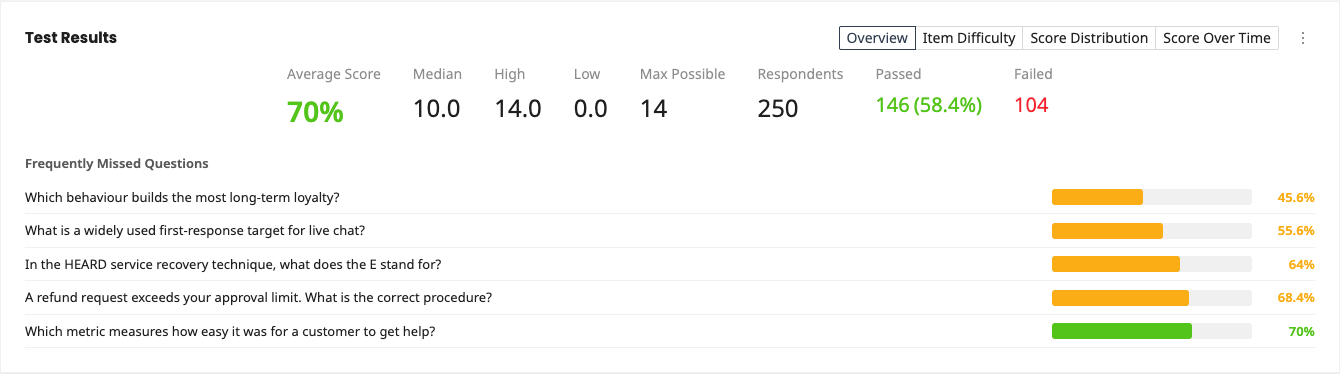
Set answer keys and point values so PaperSurvey scores incoming responses and summarizes the results.
Where it is used
- Teachers: A teacher marks a class quiz where a pupil got 42 out of 50 and wants that shown as a percentage grade.
- Workplace trainers: A trainer scores a staff safety test out of 20 and needs each result as a percentage to record who passed.
- Students: A student checks their own practice exam, entering the marks they earned and the total to see how they did.
How it works
The percentage grade is points earned divided by total points, times 100. For bulk grading of paper answer sheets, PaperSurvey can scan and score whole classes automatically.
When should you use it?
Use it any time you have a score out of a total and want it as a percentage. Maybe a student got 42 questions right out of 50, or a trainee scored 18 out of 20 on a safety check. Typing the two numbers gives you a clean percentage you can compare fairly across tests of different lengths. It saves you doing the division by hand, and it works for any subject, quiz, exam, or marked worksheet.
What does the result mean?
The result is a percentage grade, shown to one decimal place. It tells you what share of the available points were earned. A higher percentage means a better score, so 84 percent means the person got 84 out of every 100 possible points. There is no single worldwide pass mark. Many schools treat around 50 to 60 percent as a pass, but the exact cutoff depends on your school, course, or grading policy, so check the rules that apply to you.
Mistakes to avoid
Do not swap the two boxes. Points earned goes first, total points second. If you put them the wrong way round you can get a figure above 100 percent. Only type plain numbers, not percent signs, letters, or words. Leave the total as the full marks available, not the pass mark. If a test is out of 50, the total is 50, even if 30 is needed to pass. Also double-check you counted every question, so the total is correct.
How to use this calculator
- Type the points earned into the first box, labelled Points earned.
- Type the total points the test was worth into the second box, labelled Total points.
- The calculator divides the score by the total and multiplies by 100 for you.
- Read the percentage shown next to Grade; that is the score as a percentage.
Worked example
A pupil answers 42 questions correctly on a 50-question test. Type 42 in the Points earned box and 50 in the Total points box. The calculator shows 84.0 percent, so the pupil scored 84 percent.
Frequently asked questions
What do I type in the first box?
The points earned, which is the actual score the person got. For example, if they answered 42 questions correctly, type 42.
What do I type in the second box?
The total points possible, which is the highest score someone could get. If the test was out of 50, type 50.
Where do I get these numbers?
From the marked test or answer sheet. The score earned is what you counted as correct, and the total is the maximum marks the test was worth.
What does the percentage tell me?
It shows what share of the marks were earned. A result of 84 percent means 84 out of every 100 possible points were achieved.
Is a certain percentage always a pass?
No, there is no universal pass mark. Many schools use around 50 to 60 percent, but you should check the rule for your own class or course.
Get Started with PaperSurvey.io Software
Start your 14-day free trial now, no credit card required.