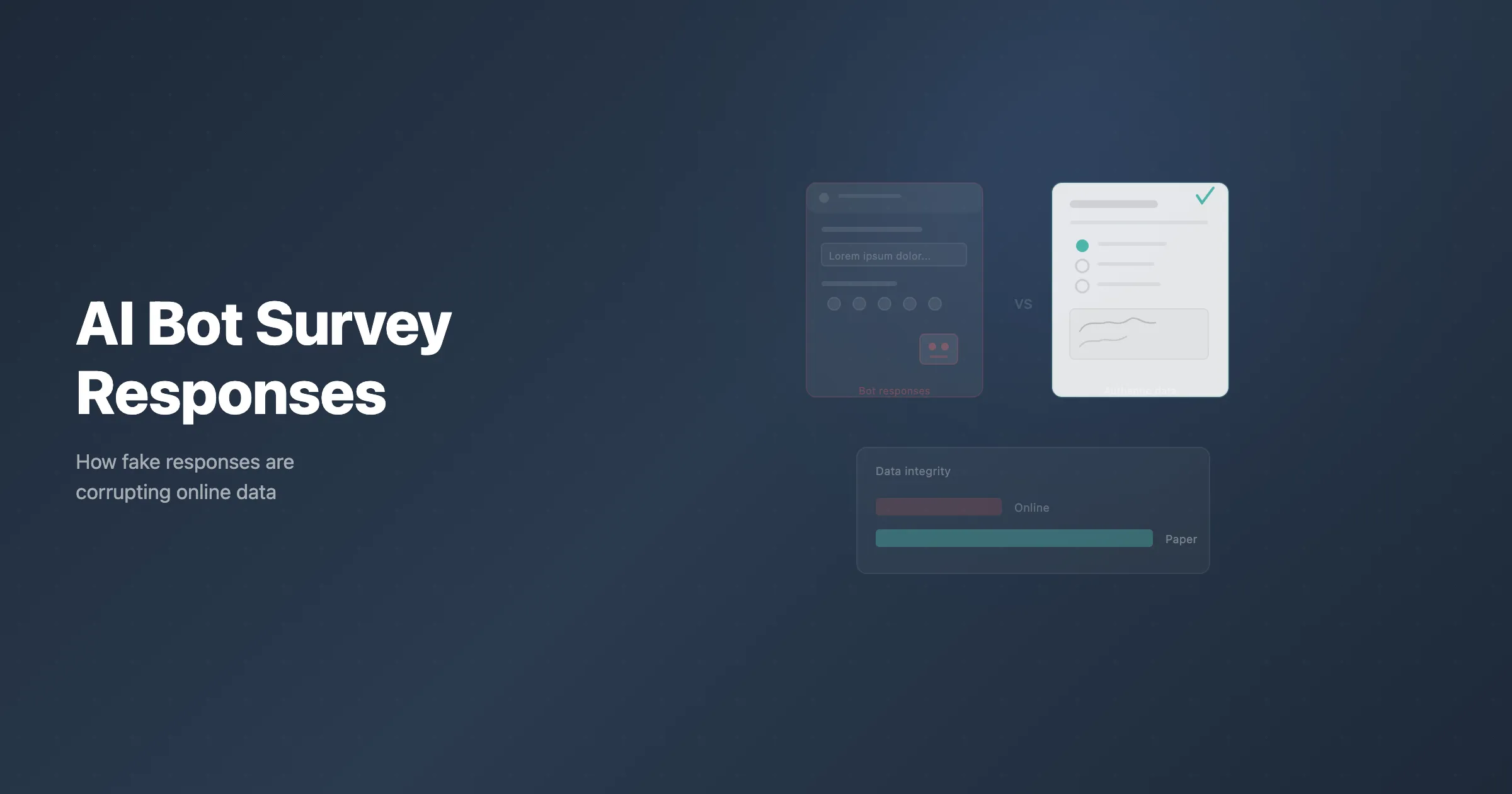
Online surveys have a growing credibility problem. AI-powered bots can now complete survey forms at scale, generating responses that are increasingly difficult to distinguish from genuine human answers. For researchers, market analysts, and anyone who depends on survey data for decision-making, this is not a theoretical concern. It is actively undermining data quality right now.
The problem goes beyond simple spam. Modern AI can read survey questions, understand context, generate plausible open-ended responses, and stay internally consistent across a multi-page questionnaire. The result is datasets contaminated with fabricated answers that pass traditional quality checks.
The scale of the problem
The barrier to generating fake survey responses has dropped to near zero. Anyone with basic programming skills can point a large language model at a set of survey questions and produce contextually appropriate answers, then feed them into the open-source tools that have automated web form submission for years.
Any publicly accessible online survey is a target. Google Forms, SurveyMonkey, Typeform, and similar tools have no built-in way to verify that a respondent is a real person giving genuine answers. A municipal government running a public consultation might receive a flood of AI-generated responses designed to skew the outcome. A company testing a product concept might find that competitors or disgruntled parties have automated submissions to distort the data.
Incentives make it worse. When a survey offers a gift card, cash, or a raffle entry, a single operator can run AI-powered bots across hundreds of survey opportunities and turn fabricated responses into real income. Survey fraud existed before AI, but AI has made it far more sophisticated and far harder to detect. Where bot responses were once obvious, with random selections, gibberish text, and impossible completion times, they now look thoughtful, coherent, and human.
Why traditional quality checks are failing
Most techniques for spotting low-quality responses were designed for a pre-AI world. Attention checks such as "Select 'Strongly Agree' for this question" are trivially passed by an AI that reads and understands the prompt. Completion-time filters assume a person cannot answer thirty questions in ninety seconds, but a bot can be told to pause realistically between questions and finish inside the expected window. Straight-line detection looks for the same option repeated down a Likert scale, yet AI generates the varied, contextually appropriate pattern researchers treat as evidence of genuine engagement.
Open-ended questions were once the reliable safeguard. A prompt like "Describe a time you experienced excellent customer service" used to defeat simple bots. AI now writes fluent, specific, emotionally plausible narratives about a fictional experience that pass human review. AI-detection tools carry the same problems here as in academic settings: high false-positive rates, inconsistent accuracy, and easy defeat by paraphrasing. CAPTCHA adds friction but does not help, because solving services are cheap and, more fundamentally, CAPTCHA only checks that a human submitted the form, not that the answers are genuine.
Why this matters
Survey-based research underpins psychology, sociology, political science, public health, education, and marketing. If a meaningful fraction of responses in a study are AI-generated, and those responses reflect patterns in the model's training data rather than the target population, the conclusions can be wrong. The researcher may never know, because the contaminated data passes every standard check before the paper is published, cited, and used to inform policy.
The stakes are just as high in business. Companies spend heavily on survey-based market research to guide product, pricing, and brand decisions. A concept that looks appealing because bots inflated the positive responses can lead to a launch that fails for reasons the research never revealed. Government agencies face the same risk when online consultations amplify certain viewpoints artificially or obscure genuine public opinion.
How paper surveys prevent AI contamination
Paper has a natural defense against AI-generated responses: physical presence. A paper survey requires someone to hold a pen, read the questions, and mark answers by hand. There is no API to automate and no way to script a remote bot to fill in a physical form. The response is an artifact of real human engagement, not a technological patch layered over a vulnerable process.
Handwriting adds its own authenticity. It shows hesitation, correction, and emphasis that are extremely hard to fabricate at scale, so a reviewer can be confident each response came from a person who was present and engaged. The economics reinforce this, because large-scale fraud depends on automation and each paper response takes physical effort. Controlled distribution in classrooms, clinics, workplaces, and field sites also means the researcher knows who received a form and under what conditions, visibility that online collection rarely offers.
It helps to be precise about where paper's advantage actually lies. Against careless human responding, the two self-administered modes are comparable: contrary to a common assumption, web surveys do not reliably produce more careless straightlining than paper, and across four national experiments with 6,219 respondents there was no evidence of more satisficing online (Kim et al., 2019; Clement et al., 2023). Paper's distinct edge is against automated contamination, not ordinary human inattention.
Practical recommendations
For high-stakes research where findings will drive important decisions, administer paper surveys in controlled environments. For mixed-mode studies, combine paper and online collection and compare response patterns between modes to surface quality differences. For online surveys you cannot replace, layer open-ended questions, behavioral analysis, IP and geolocation checks, and post-hoc statistical screening, and report your data-quality procedures transparently, because none of these measures are foolproof.
Organizational surveys deserve special attention. For employee engagement, patient satisfaction, or student evaluations, paper administration in a controlled setting ensures the person completing the form belongs to the target population. It also encourages candor: because paper is self-administered rather than interviewer-led, a record-validated study found that people answer sensitive questions more honestly on a self-administered form than to an interviewer, with self-administered respondents underreporting an unflattering fact far less often (Kreuter, Presser & Tourangeau, 2008).
The old barriers that made paper burdensome, such as manual data entry, physical storage, and slow processing, have largely been eliminated by modern scanning and recognition. Platforms like PaperSurvey.io let researchers design paper surveys, distribute them, scan completed forms in bulk, and extract data automatically with OMR and OCR. The output lands in the same digital format as online survey data, ready for SPSS, Excel, R, or any other statistical tool.
Try It Free
The rise of AI-generated responses is part of a broader erosion of trust in data collected through digital channels, and paper offers an authenticity guarantee that no amount of digital verification can match. When data integrity matters, the medium matters too. Start your free trial and see how paper-based collection moves securely from the page to a clean, analyzable dataset.