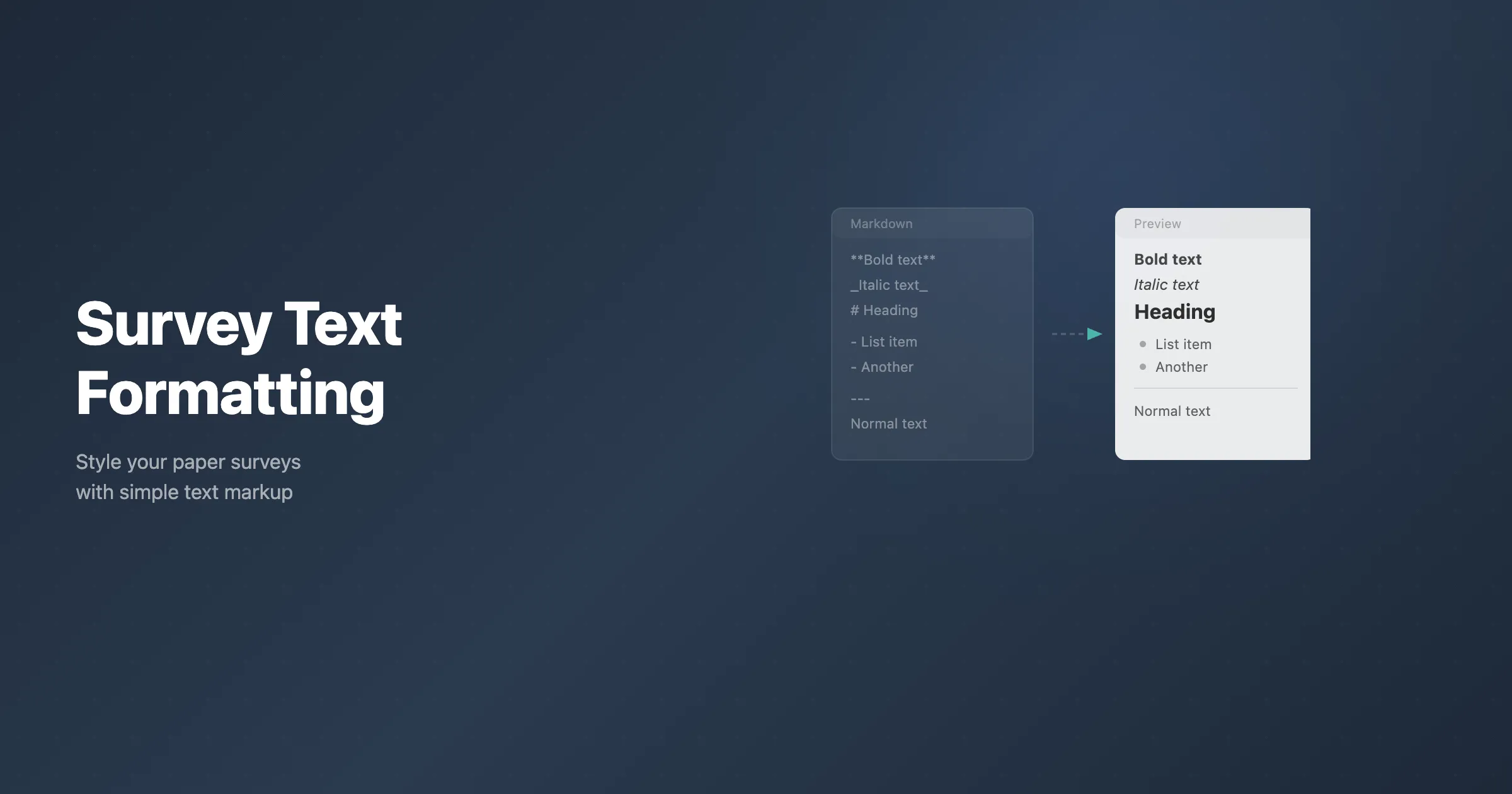
Use formatting to make questions easier to read and instructions easier to follow. PaperSurvey.io supports a small set of Markdown conventions and shortcodes such as [br] and [highlight=FFF2B3]text[/highlight].
Each example below has a Copy button. Paste the source into your survey, then replace the sample wording. Close paired tags in reverse order: [highlight=FFF2B3][b]Important[/b][/highlight].
The results are browser illustrations, not generated PDF previews. Your survey's font, text size, colors and layout affect the printed result. Check the paper preview before publishing, especially after changing spacing, dimensions or page breaks. Paper layout commands do not necessarily carry over to web surveys.
Text formatting
Color
Wrap text in [color=HEX]…[/color]. Use a six-digit HEX value, with or without #, or a named color such as navy. Choose a dark color that remains readable on white paper.
[color=003399]Please answer every question.[/color]Use [color=primary]text[/color] for the survey's Heading/Divider color, or [color=secondary]text[/color] for its Secondary color. Web surveys may adjust text colors for contrast.
Highlight background
Highlight a short instruction with [highlight=HEX]…[/highlight]. A pale background with dark text is usually easier to read than a bright fill. Keep highlights short so they fit on the printed line.
[highlight=FFF2B3]Choose one answer.[/highlight]For a dark background, set a contrasting text color inside the highlight. The closing color tag goes before the closing highlight tag.
[highlight=243746][color=FFFFFF]Staff use only[/color][/highlight][highlight=primary]text[/highlight] and [highlight=secondary]text[/highlight] use the same survey colors described above. Check that the text remains legible when printed in grayscale.
Bold
Use two asterisks, or the paired shortcode [b]…[/b].
Please select **one answer**.Italics
Use one asterisk, one underscore, or [i]…[/i].
Think about *the past week*.Strikethrough
Use two tildes around the text to cross out.
Available ~~Monday~~ Tuesday.Underline
Use two underscores, or [u]…[/u]. In PaperSurvey.io, double underscores mean underline, even though some Markdown editors use them for bold.
Write your __full name__.Headings
Start a line with one, two or three # characters followed by a space. Use a Description question for a block of introductory text with headings.
# Main heading
## Section heading
### SubheadingUnformatted text
Use [unformatted]…[/unformatted] to return part of bold or italic text to normal styling.
**Your name [unformatted](optional)[/unformatted]**Font sizes
Wrap text in one of these tags, from smallest to largest. Sizes are relative to the survey's text size; the illustration does not specify exact printed point sizes.
[tiny]Tiny text[/tiny]
[small]Small text[/small]
[s]S text[/s]
[normal]Normal text[/normal]
[large]Large text[/large]
[larger]Larger text[/larger]
[xl]Xl text[/xl]
[xxl]Xxl text[/xxl]Text rotation
Use [rotate=ANGLE]…[/rotate] to rotate printed text by a number of degrees. Positive angles rotate counterclockwise; negative angles rotate clockwise. Web surveys show the text without rotation.
[rotate=90]Label[/rotate]Lists
Use a Description question for lists. Keep lists to one level.
Unordered
Start each item with an asterisk and a space.
* Bring your ID
* Use a black pen
* Return the completed form- Bring your ID
- Use a black pen
- Return the completed form
Ordered
Start each item with its number, a period and a space.
1. Read the question
2. Choose an answer
3. Mark the box- Read the question
- Choose an answer
- Mark the box
Tables
Use a Description question for a Markdown table. Separate columns with |, put a separator row after the header, and keep the same number of columns on every row. These are text tables; use a grid question when respondents need to select answers.
Basic Table
| Session | Room |
|---------|------|
| Morning | A    |
| Evening | B || Session | Room |
|---|---|
| Morning | A |
| Evening | B |
Column Alignment
Use :--- for left alignment, :---: for center alignment, or ---: for right alignment in the separator row.
| Left | Center | Right |
|:-----|:------:|------:|
| A    | B      | C     |
| 100 | 200 | 300 || Left | Center | Right |
|---|---|---|
| A | B | C |
| 100 | 200 | 300 |
Keep tables narrow enough for the page. Long cell contents and extra columns can make a printed table overflow.
Spacing and alignment
Centered text
Use [center]…[/center] or the spelling [centre]…[/centre].
[center]Thank you for taking part.[/center]Right-aligned text
Use [right]…[/right]. Use [left]…[/left] when you need to explicitly restore left alignment.
[right]Office use only[/right]Horizontal & Vertical spacing
Use [hspace=0.5] for horizontal space or [vspace=0.5] for vertical space. A bare number is measured in centimeters. The longer aliases are [horizontalspace=0.5] and [verticalspace=0.5].
These commands control the printed layout; web surveys remove these explicit spacing commands. In the Design layout, values may use mm, cm, in (inches) or pt (points). For example, [hspace=0.25in] adds a quarter-inch horizontal gap, and [vspace=0.5in] adds half an inch vertically. Write fractional inches as decimals, such as 0.25in, rather than 1/4in or an inch quotation mark.
Name:[hspace=0.5]______Here is the same kind of gap expressed in inches for the Design layout:
Name:[hspace=0.25in]______Older paper layouts: spacing commands read the number as centimeters even when a unit is written after it. Convert inches to centimeters by multiplying by 2.54. For example, use [hspace=0.635] for a quarter inch or [vspace=1.27] for half an inch. Do not use the in suffix for spacing in those layouts.
The fixed shortcuts always keep these sizes; they do not change with your unit preference:
| Shortcut | Centimeters | Inches (approximately) |
|---|---|---|
[smallspace] |
0.1 cm | 0.04 in |
[space] |
0.5 cm | 0.20 in |
[midspace] |
1.5 cm | 0.59 in |
[bigspace] |
3 cm | 1.18 in |
Do not rely on these physical widths in a web survey. Negative explicit spacing is supported on paper, but can cause text to overlap response boxes.
Align text to right
Use [pushright] between two pieces of text to push the text after it toward the right edge of the printed line. [fill] is a shorter alias with the same behavior. In web surveys, both commands become a space rather than right-aligning the text.
Name [pushright] DateFixed width or height box
Use [width=6cm]…[/width] to reserve a text width, or [width=50%]…[/width] for a fraction of the available width. Use [height=3cm]…[/height] for a physical height, or [height=2 lines]…[/height] for a number of lines at the current text size. Include a unit; bare width and height numbers are not valid.
Width and height blocks also accept inches: [width=2in]text[/width] reserves a two-inch width, and [height=0.5in]text[/height] reserves half an inch of height. Unlike the spacing commands above, physical units in these blocks also work in older paper layouts.
You can nest width and height tags. The outlined area below shows the reserved space; the shortcode itself does not print a border.
[height=2cm][width=5cm]Office use only[/width][/height]Place prefill list variables inside a height block so varying values do not move the rest of the form. A height in lines shrinks longer text to fit. Replace NAME below with a column from your prefill list.
[height=2 lines]{{ NAME }}[/height]Page break
Use a Page break question to start a new page, or insert [pagebreak] into text where supported. The shortcode may not work inside a Heading question. A paper page break does not create a new web-survey page.
End of section one.[pagebreak]Start of section two.Line break
Press Enter in the editor, or insert [br] or [newline] to start a new line. This is useful for long row and column labels in grid questions.
Very satisfied[br]with the servicewith the service
Large Line break
Use [linebreak] for a larger gap between blocks of text. The amount of space differs between the paper and web renderers.
Section one.[linebreak]Section two.Section two.
Horizontal line
Use [hr] for a horizontal rule. On paper, it uses the survey's heading color.
Before the line.[hr]After the line.After the line.
Line
Six underscores, ______, create a solid line that fills the available space on paper.
Signature: ______Dotted line
Six dots, ......, create a dotted fill line on paper.
Name: ......Pagination
Use [currentpage] for the current printed page number and [lastpage] for the total number of printed pages.
Page [currentpage] of [lastpage]Use [page=2]text[/page] to show text only on printed page 2. Replace 2 with the page number you need.
Paper-only and web-only text
Use [paper]…[/paper] for instructions that should appear only on the printed form, and [web]…[/web] for instructions that should appear only online.
[paper]Mark one box with a black pen.[/paper]
[web]Select one answer below.[/web]Question references and inline fields
Question numbers
In a question's text, [qnum:123] refers to the displayed number of question ID 123. Replace the ID with a question from the same survey and enable question numbering. This keeps the reference in step when questions are reordered.
If you answered Yes to question [qnum:123], continue below.Inline text and number fields
Create an Insert Text or Insert Number question first, then insert its shortcode into the surrounding text. [text=123] needs a matching Insert Text question; [number=456] needs a matching Insert Number question. Replace the example IDs with your own. Each field can be inserted only once in a printed form.
Insert Number fields contain integer digit boxes, not decimal fields. Online, these shortcodes become blank lines rather than interactive inputs.
Name: [text=123]
Age: [number=456]Repeated sections
Within repeated question text, [counter] shows the current repetition and [max_counter] shows the configured number of repetitions. These need a repeated section; they are not general page counters.
Person [counter] of [max_counter]Symbols and equations
Checkbox symbols
Use these shortcodes to illustrate how to mark a paper form. They print symbols, not new response fields. For answers you want to scan, create a question or an inline field instead.
| Purpose | Shortcodes |
|---|---|
| Empty checkbox symbols | [checkbox], [multicheckbox] |
| Checked symbols | [check], [multicheck], [singlecheck] |
| Filled symbols | [filled], [multifilled], [singlefilled] |
| Corrected symbol | [correct] |
| Large square symbol | [box] |
The printed shape depends on the variant and survey configuration. Check the paper preview when demonstrating marking instructions.
Faces
[sad], [neutral] and [smile] print facial-expression symbols. For a five-step scale, use [smile=1] through [smile=5], from most negative to most positive. Both kinds print as drawn faces on paper and show as the matching emoji on web surveys.
[sad] [neutral] [smile][smile=1] [smile=2] [smile=3] [smile=4] [smile=5]Arithmetic exercises
[equation]…[/equation] lays out a two-number arithmetic exercise vertically on paper. Use non-negative whole numbers with an operator such as +, -, x, *, ×, ÷ or /. It is not a general equation editor and does not calculate an answer for the respondent.
[equation]100+999[/equation]Links, QR codes and images
Web survey link
[link] prints the link to this survey's web version. [websurvey_qrcode] prints a QR code for the same link, with a default height of 15 mm. Add height=2cm to change its size.
Keep this extra QR code away from the form's scanning markers and reserved QR areas, particularly the top-left and bottom-right corners.
Complete this survey online: [link]
[websurvey_qrcode height=2cm]Images
Upload an image in the survey editor, then use its image name between [img] and [/img]. The built-in logo name can be used to try the syntax. Image-upload availability depends on your account's features.
[img width=5 center]logo[/img]| Syntax | Purpose |
|---|---|
[img]logo[/img] |
Use the available width. |
[img width=half]logo[/img] |
Use half the available width. |
[img width=third]logo[/img] |
Use one third of the available width. |
[img width=5 height=3]logo[/img] |
Set dimensions in centimeters. |
[img width=5 left]logo[/img] |
Align the image left. |
[img width=5 right]logo[/img] |
Align the image right. |
For advanced paper placement, image tags also accept x, y and relative. Use the editor's positioning tools and check the PDF rather than guessing coordinates. The Design layout understands explicit physical units for image width and height; bare centimeter values work across layouts.
Multilingual text
Use [arabic]…[/arabic] for Arabic text within a survey in another language, and [latin]…[/latin] for Latin-script text within an Arabic survey. Your selected font must include the characters you need.
Survey: [arabic]استطلاع رأي[/arabic][rtl]…[/rtl] is also available for right-to-left blocks on paper. A legacy [ltr]…[/ltr] wrapper exists, but [latin]…[/latin] is the preferred choice for Latin-script passages; check mixed-direction text in the generated PDF.
Other short-codes
Use [page=2]text[/page] to show text only on a specified printed page. Replace 2 with the page number you need.
Use the editor's page, column and question layout controls for larger changes. Shortcodes are most useful for small adjustments within text.
Before you print
- Close every paired tag, including nested width, height, color and highlight tags.
- Replace example question IDs and prefill list column names with values from your survey.
- Check both paper and web previews if you distribute the survey in both formats.
- Keep response boxes and scanning markers clear of text, images and extra QR codes.
- Print one sample at the intended scale before distributing a full batch.